An Aesthetics of Imbalance, Between Gesture, Symbolism, and Critical Thought
— Thierry Tessier
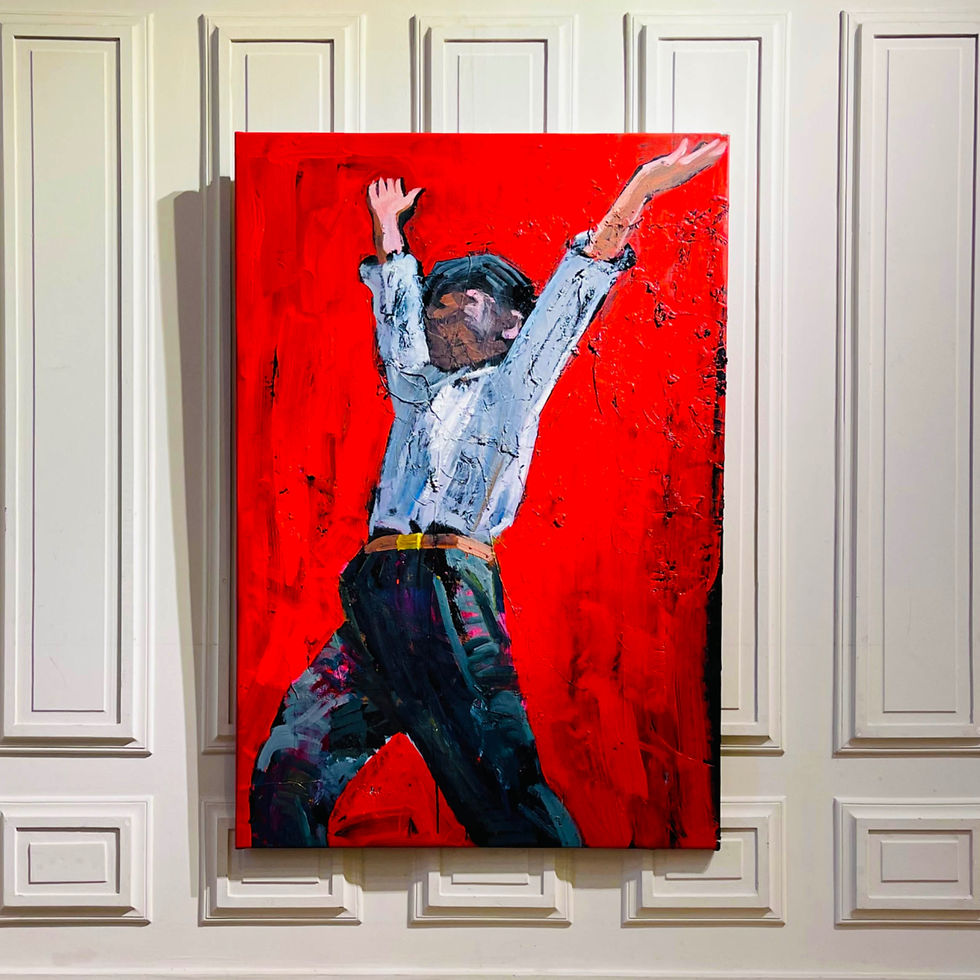
Pavlov's child 9 is a 2022 painting on canvas by artist luhang 路航, using oil, continuing an exploration within the Pavlov's child series. Pavlov's child 9, painting on canvas using oil, depicting a dynamic human figure with raised arms and a blurred face against a vibrant, textured red background, by artist luhang 路航, 2022.

Pavlov's child 9 is a 2022 painting on canvas by artist luhang 路航, using oil, continuing an exploration within the Pavlov's child series. Pavlov's child 9, painting on canvas using oil, depicting a dynamic human figure with raised arms and a blurred face against a vibrant, textured red background, by artist luhang 路航, 2022.
The artistic approach of LU Hang(路航) is distinguished by a profound articulation between pictorial form, the gestural language of the human body, and a critical reflection on history, society, and existence. Through a pared-down visual vocabulary charged with symbolic resonance, LU develops a demanding body of work grounded in a constant tension between image, sign, and meaning. His practice, both intuitive and conceptual, unfolds as a field of visual reflection on the human condition in its bodily, existential, and collective dimensions.
At the heart of his painting, the body becomes a sign. Condensed gestures, tense limbs, crouched or suspended postures compose a visual language that the artist conceives not as a simple representation of movement, but as a pictorial writing in its own right. In his series Gymnastics and Dance, corporeality frees itself from traditional narrative to become a vehicle for psychic tensions, thwarted impulses, and metaphysical imbalance. Gesture thus oscillates between effort and surrender, revolt and submission, expansion and withdrawal. It becomes a plastic vector of human uncertainty.
Pavlov's child 9 | 2022 | Oil on canvas | 145 x 100cm
This dynamic finds an echo in the arrangement of pictorial space. Far from illusionistic depth, LU Hang favors stripped-down backgrounds and austere or symbolically enclosed scenes, reinforcing a sensation of confinement and alienation. Space functions both as stage and trap: a theatrical stage where the conflicts of body and mind are replayed, and a visual trap where existential emptiness and the search for meaning crystallize. In the Bowls series, this tension reaches a dramatic intensity: anonymous nude figures, crawling or frozen, converge toward—or flee from—an empty bowl placed at the center like an absurd totem.


The bowl, a recurring element, embodies a double-edged symbol. As a container, it represents waiting, lack, hunger—both physical and spiritual. Yet when empty, it becomes a mirror of impossible fullness, a metaphor for desire without an object, an allegory of existential emptiness. LU Hang does not depict social misery; instead, through a minimalist pictorial syntax, he transposes the metaphysical condition of modern humanity: isolated, fragmented, struggling with a material world that no longer responds.
The influences acknowledged by the artist reveal a thought rooted in the Western pictorial tradition while simultaneously subverting it. Echoes of Francisco Goya appear in the grotesque, the fantastic, and social critique; those of Francis Bacon in the distortion of bodies and psychological intensity; and those of Henri Matisse in the construction of bodily rhythm—though inverted, where chromatic joy becomes a cold tension. LU Hang does not quote; he reformulates, transposes, and shifts these inheritances in order to give them a universal and contemporary resonance.
The series Four Horsemen, still in development, extends this symbolic dimension toward a reinterpretation of apocalyptic archetypes. These biblical figures, far from distant allegories, are reinvested as intimate forces—latent entities inhabiting both bodies and collectives. In doing so, LU Hang connects mythology, art history, and contemporary social pathologies, tracing a pictorial genealogy of violence, fear, and the loss of self.
The artist’s interest in collective forms of loss of control—such as the “dancing plagues” studied in cultural history—nourishes this critique of the present. By making visible the contagion of gestures and the dissolution of the subject within the crowd, LU Hang points to the ambiguity of contemporary social bonds: at times refuge, at times tyranny. He questions the ritualized madness embedded within norms, identities, and forms of belonging.
This critical gaze on society is also embodied in his treatment of objects. In the Bread series, a simple loaf becomes the emblem of the conflict between material necessity and spiritual aspiration. Isolated within the composition and rendered with almost tactile precision, bread is no longer food but a trial: the trial of choice, freedom, and survival. LU Hang evokes here the thought of Martin Heidegger, for whom objects, far from being neutral, reveal our way of inhabiting the world. Bread becomes a trace of the human — marked by labor, suffering, and time.
Behind this formal reduction, LU Hang pursues a philosophical exploration that goes beyond painting alone. He asks: how can vulnerability be represented without falling into a posture of victimhood? How can the body be inscribed within history without imprisoning it in identity? And finally, how can one create work in a world saturated with images? His response lies in the rigor of gesture, symbolic density, and visual economy that leave space for silence, enigma, and doubt.
His painting is thus traversed by a tension between the figurable and the unfigurable, between anchoring in reality and drifting toward abstraction. The image is never closed: it wavers, distorts, and alters before our eyes, in a dynamic close to alienation. The very process of creation, as described by the artist, is conceived as an uncertain ritual in which chance, accident, and the unconscious participate in the formation of meaning.


No 27 1 | 2024 | Oil on canvas | 200 × 150 cm
The question of sacrifice, recurrent in his recent series, is less a glorification of martyrdom than a reflection on the tragic condition of both art and humanity. To dance until collapse, to paint until form disappears, to hollow out everyday objects until their symbolic implosion—this is the path chosen by LU Hang to render the invisible visible, to translate contemporary experience in what it has that is most disorienting, most silent, yet also most universal.
In short, LU Hang conceives painting as a battlefield between the sensible and the intelligible, between the cry and silence. Through exhausted figures, desacralized objects, and empty spaces, he constructs a work of limits and thresholds, where the viewer is invited not to understand but to feel—to confront their own zones of shadow. It is in this disturbance that the power of his art resides.
Bread | 2022 | Oil on canvas | 175 x 140cm